
The 12 Best Market Research Tools for Strategic Insights in 2026
Discover the best market research tools for any use case. A curated guide to platforms for surveys, competitive intelligence, and rapid market scans.

In today's competitive environment, the speed and accuracy of market research can define success. Yet, the sheer volume of available tools, from enterprise-grade platforms to nimble pay-per-report services, often leads to analysis paralysis. Choosing the wrong tool results in wasted budget and delayed insights, while the right one empowers teams to make confident, data-backed decisions quickly.
This guide cuts through the noise. We provide a curated, comparative analysis of the best market research tools, organized by primary use case to help you find the perfect fit for your specific needs. Forget sifting through generic marketing copy; we offer a practical evaluation of each platform.
Inside this resource, you will find:
- Categorized breakdowns: Tools are grouped by their core function, including rapid market scans, deep quantitative analysis, survey deployment, and competitive intelligence.
- Concise evaluations: We assess each tool on critical criteria like speed, cost, data quality, and exportability.
- Actionable details: Each review includes ideal user personas, pros and cons, and direct links, helping you match the right solution to your project, timeline, and budget.
Whether you are a strategy consultant needing a market snapshot for a client presentation, a startup founder validating a new concept, or a product manager tracking competitor movements, this guide is designed to help you select the optimal tool efficiently. Let’s dive in.
1. StatsHub.ai
Best for: Rapid, Affordable Market Opportunity Assessment
StatsHub.ai distinguishes itself as one of the best market research tools by delivering a potent combination of speed, affordability, and decision-ready insights. It addresses a critical pain point for strategy, product, and investment teams: the need for credible market data under tight deadlines and budgets. Instead of commissioning expensive, time-consuming projects for initial validation, users can generate a comprehensive, slide-ready market report on any industry or niche for a flat $15 fee. The platform transforms a simple keyword query into a structured analysis in just minutes.
This tool is engineered for immediate application. Each report arrives as both a PDF and an editable file, allowing teams to seamlessly integrate charts and tables into investor decks, board presentations, or go-to-market briefs. The structure is meticulously designed for strategic use, including an executive summary, market sizing data, regional breakdowns, and crucial competitive benchmarking. This built-in analysis saves teams from the manual, time-consuming work of synthesizing raw data into a coherent narrative.
Expert Insight: "We used the report to prep a market sizing update in under an hour. The instant, structured output allowed us to focus on strategy instead of data collection." - Sergio Rossi, Strategy Analyst
Core Features & Analysis
StatsHub.ai's value proposition is centered on its structured, high-utility output and transparent methodology.
- Comprehensive Report Structure: Every report includes an executive summary, global market size and growth rates, regional analysis (Americas, APAC, Europe, MEA), segmentation (by type and application), and demand/supply drivers.
- Built-in Competitive Benchmarking: A standout feature is the competitive landscape table, which compares key players on metrics like revenue, 5-year CAGR, net margin, and regional dependence. This provides a defensible snapshot for stakeholder meetings.
- Transparent Methodology: Each report cites its sources and outlines the methodology used, adding a layer of credibility that is often missing in low-cost data tools. This transparency is crucial for teams that need to validate their findings.
- Pay-Per-Report Model: The simple, one-time $15 pricing per report eliminates subscription friction, making it an accessible tool for ad-hoc needs, from validating a startup idea to prepping for a sales call.
Use Case & Implementation
StatsHub.ai is an ideal first step in the research process. Use it to quickly scope a new market, validate an investment hypothesis, or add quantitative weight to a strategic plan. Its "slide-ready" format means you can go from question to presentation in less than an hour, making it a powerful tool for accelerating decision-making cycles.
Website: https://www.statshub.ai
2. G2
G2 isn't a market research tool itself, but rather a meta-tool for researching the B2B software market, making it an indispensable starting point for finding the best market research tools. It functions as a peer-review marketplace where verified users rate software across numerous categories. Its primary value lies in its structured, data-driven approach to software comparison, which is crucial for building a shortlist of potential solutions before committing to demos.
The platform’s quarterly Grid and Index reports are particularly powerful. These reports plot vendors on a quadrant based on market presence and user satisfaction scores, offering a visual shortcut to identify established leaders, high-momentum contenders, and niche specialists. This transparent scoring methodology helps you cut through marketing noise and focus on tools with proven track records.
Evaluation and Key Features
| Category | Analysis |
|---|---|
| Ideal Use Case | Initial vendor discovery and creating a shortlist for a specific market research need (e.g., survey software, competitive intelligence platforms). |
| Data Quality | High, as reviews are verified. However, it's essential to analyze the context of reviews, as satisfaction can be subjective. |
| Pricing | Free to access all reports and reviews. Vendor pricing information is often unlisted or requires direct inquiry. |
| Unique Feature | The Momentum Grid report, which identifies products with the fastest-growing satisfaction scores and market presence, is invaluable for spotting emerging leaders. |
Pros:
- Large, consistently updated database of verified B2B software reviews.
- Excellent for comparing alternatives and validating vendor claims.
- Transparent report methodologies provide a clear framework for evaluation.
Cons:
- Vendor profiles can feature paid placements, potentially influencing visibility.
- Lacks verified pricing for many tools, requiring further research.
Actionable Tip: Use G2’s category filters to narrow down your search (e.g., "Market Intelligence" or "Survey"), then download the corresponding Grid Report. Focus on vendors in the "Leaders" and "High Performers" quadrants to build your initial consideration set.
Website: https://www.g2.com
3. Capterra
Similar to G2, Capterra operates as a comprehensive software discovery platform rather than a direct market research tool. As part of Gartner Digital Markets, it provides an extensive directory where users can find, compare, and read reviews on hundreds of business software solutions, including a robust category dedicated to market research. Its primary value for market researchers is in the initial discovery and vetting phase, allowing for broad comparisons based on features, deployment models, and user ratings.
The platform excels at simplifying the first-pass vendor evaluation process. Users can apply granular filters to narrow the field from over 200 market research tools, sorting by "Highest Rated" or "Most Reviews" to quickly identify popular and well-regarded options. This functionality is invaluable for teams needing to build a long list of potential tools for a specific function, such as survey creation or competitive intelligence, before diving into deeper analysis.
Evaluation and Key Features
| Category | Analysis |
|---|---|
| Ideal Use Case | Initial discovery of niche or mainstream market research software, and side-by-side comparison of features and user ratings to create a vendor long list. |
| Data Quality | High, as reviews are from verified users. However, sponsored placements are clearly marked and may appear before organic results, requiring user discernment. |
| Pricing | Free for users to browse and compare software. Pricing for individual tools must be obtained directly from the vendors. |
| Unique Feature | The side-by-side comparison feature allows you to select several vendors and view their features, ratings, and pricing models in a clean, comparative table, streamlining the shortlisting process. |
Pros:
- Free to use with broad coverage of vendors across the market research spectrum.
- Excellent filtering capabilities make it easy to narrow down a large list of candidates.
- Transparently discloses sponsored listings, helping users distinguish paid placements.
Cons:
- Sponsored listings can influence initial visibility, potentially pushing relevant organic results down.
- The depth of information, particularly for complex enterprise tools, can vary significantly between vendor profiles.
Actionable Tip: Use the "Compare" checkbox on several promising tools within the market research software category. This generates a custom comparison table that highlights key differences in features and ratings, providing a quick, data-driven way to eliminate options that don't meet your core requirements.
Website: https://www.capterra.com/market-research-software/
4. Similarweb
Similarweb is a digital intelligence platform that provides a comprehensive view of website traffic, mobile app usage, and overall online market dynamics. It excels at delivering high-level competitive intelligence, allowing users to benchmark their digital performance against competitors and understand the broader industry landscape. Its primary function is to transform raw digital signals into actionable insights for market sizing, channel optimization, and audience analysis.
The platform's strength lies in its ability to deconstruct a competitor's digital strategy. With Similarweb, you can analyze traffic sources, audience demographics, and engagement metrics for virtually any website, revealing which channels are driving their growth. This makes it an essential tool for identifying new market opportunities, spotting emerging competitors, and refining your own go-to-market strategy based on proven digital tactics.
Evaluation and Key Features
| Category | Analysis |
|---|---|
| Ideal Use Case | Competitive benchmarking, digital channel analysis, and identifying top referral sources or advertising partners in a specific industry. |
| Data Quality | Strong for directional trend analysis and high-level traffic estimates. Data is modeled from a large panel, so it's best used for comparative, not absolute, figures. |
| Pricing | Offers several self-serve plans (Starter, Professional) with free trial options. Enterprise-grade Team and Business packages require sales engagement for custom pricing. |
| Unique Feature | The Marketing Channels analysis, which breaks down a competitor's traffic by source (e.g., Direct, Search, Social, Referral), offers an immediate blueprint of their digital strategy. |
Pros:
- Broad digital coverage for quick category scans and competitor benchmarks.
- Self-serve plans and free trials make it accessible for smaller teams.
- Intuitive interface provides clear, slide-ready visualizations.
Cons:
- Historical data depth and geographic granularity are limited in lower-cost tiers.
- Access to advanced features like audience overlap requires enterprise-level plans.
Actionable Tip: Use the "Compare" feature to benchmark up to five websites simultaneously. Focus on the "Traffic and Engagement" and "Marketing Channels" sections to create a clear competitive snapshot for stakeholder presentations.
Website: https://www.similarweb.com/corp/pricing/
5. Semrush
While primarily known as an SEO and digital marketing suite, Semrush offers a powerful competitive research toolkit that provides crucial market intelligence. Its Traffic Analytics and Market Explorer tools are particularly effective for go-to-market sizing, estimating market share, and benchmarking against competitors. This makes it one of the best market research tools for teams that need to blend top-level market analysis with granular digital channel performance data.
Semrush excels at mapping entire market categories, revealing key players, their traffic sources, and audience demographics. It translates complex web traffic data into understandable market share estimates and growth trends. This integrated approach allows marketers and analysts to see not just who is winning, but how they are winning online, from their advertising strategy to their content footprint.
Evaluation and Key Features
| Category | Analysis |
|---|---|
| Ideal Use Case | Digital-first market sizing, competitive benchmarking for go-to-market strategy, and analyzing audience overlap between key players. |
| Data Quality | Strong for digital channels, but traffic estimates are model-based. Best used for directional analysis and trends rather than absolute figures. |
| Pricing | Tiered subscription model. Core market research tools like Traffic Analytics and Market Explorer often require higher-tier plans or are sold as separate add-ons. |
| Unique Feature | The Market Explorer tool, which provides a "Growth Quadrant" to visualize competitors based on their traffic size and growth rate, offering a quick snapshot of market dynamics. |
Pros:
- Marketer-friendly UI combines market intelligence with tactical execution tools (SEO, Ads).
- Modular add-ons allow teams to customize subscriptions for specific needs.
- Excellent for understanding the digital footprint and strategy of competitors.
Cons:
- Core market and traffic analysis features are often gated behind expensive add-ons.
- Advanced traffic data is based on statistical modeling and may require cross-validation with other sources.
Actionable Tip: Use the Market Explorer to define your competitive landscape first. Then, dive into the Traffic Analytics tool for your top 3-5 competitors to compare their audience acquisition channels and identify strategic gaps or opportunities in their marketing mix.
Website: https://www.semrush.com
6. Statista
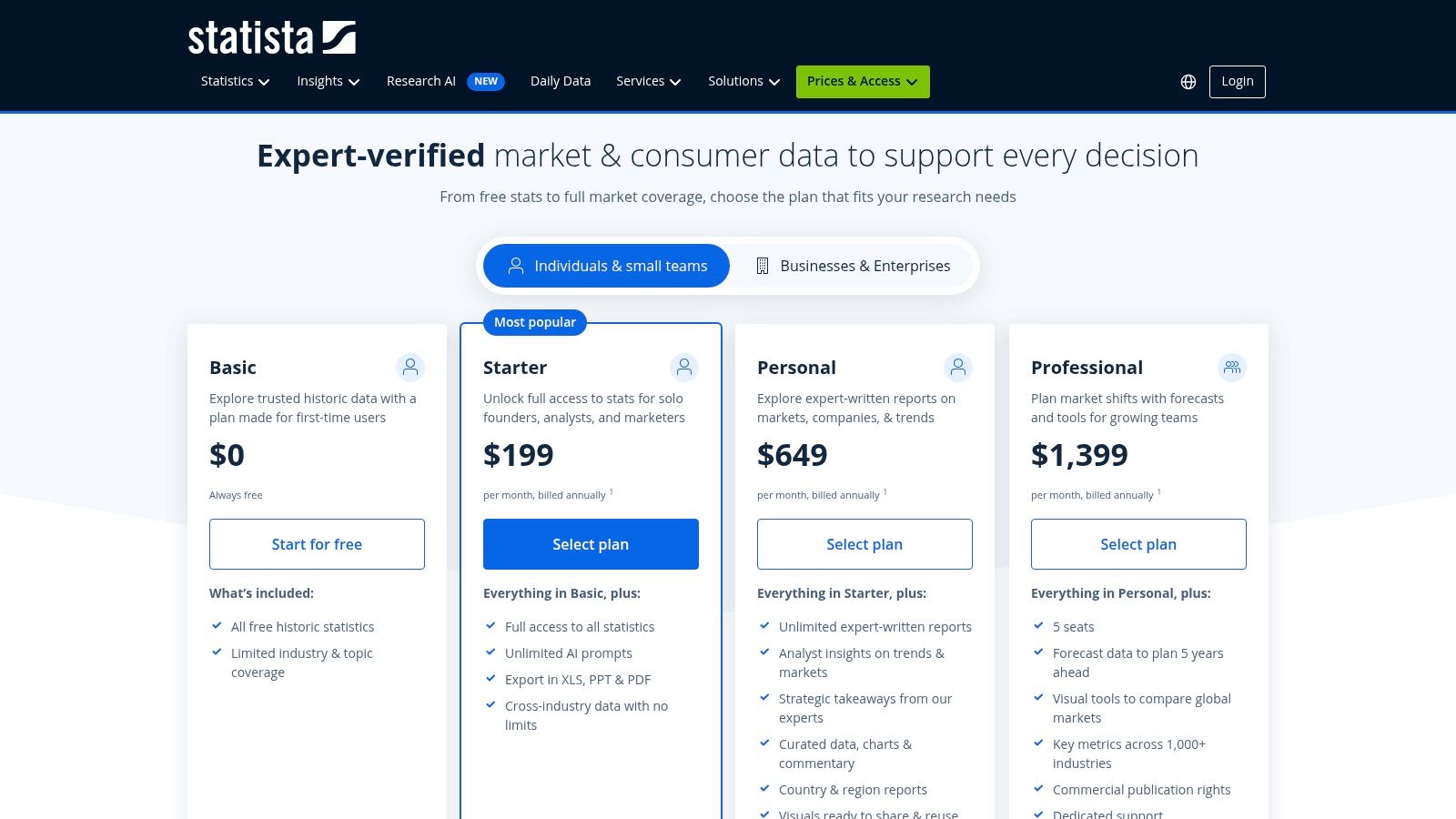
Statista is a leading market and consumer data platform renowned for its ability to provide on-demand statistics, charts, and industry reports. Its core strength lies in aggregating data from thousands of sources and presenting it in clean, exportable, and citation-ready formats. This makes it an essential tool for professionals needing quick, reliable market snapshots and slide-ready figures without conducting primary research.
The platform excels at delivering immediate quantitative context on a vast range of topics, from consumer behavior trends to detailed industry forecasts. With its powerful AI-assisted search and instant download options for XLS, PPT, and PDF, Statista streamlines the workflow for analysts, consultants, and marketers who need to quickly substantiate their findings with credible data points, making it one of the best market research tools for rapid analysis.
Evaluation and Key Features
| Category | Analysis |
|---|---|
| Ideal Use Case | Finding and exporting specific data points, market size figures, and consumer trend charts for presentations, reports, and strategic planning. |
| Data Quality | High, as data is aggregated from reputable market research firms, trade publications, and government sources. Sources are always cited for verification. |
| Pricing | Offers a free basic account with limited access. Paid individual and business plans unlock full data access, with most requiring annual billing. |
| Unique Feature | The publication-ready chart export feature, which allows users to download professionally designed visuals in multiple formats, saves significant time in report and presentation building. |
Pros:
- Extensive cross-industry coverage with easily searchable data points.
- Fast workflow for getting numbers and charts for presentations.
- Clear plan tiers and inclusions for individuals and teams.
Cons:
- Deeper datasets and full reports are often locked behind higher-cost plans.
- Paid plans commonly require an annual billing commitment.
Actionable Tip: Use Statista's "Market Insights" section to access comprehensive dashboards on specific markets like "Digital & Trend" or "Consumer." These insights provide curated forecasts and key performance indicators that go beyond a simple statistic search.
Website: https://www.statista.com/accounts/individuals/
7. Euromonitor (Passport)
Euromonitor is a global market intelligence firm whose flagship product, Passport, serves as a cornerstone for deep-dive industry and consumer analysis. While many tools focus on digital signals, Passport provides foundational, standardized data on physical industries, consumer trends, and economic indicators across more than 200 countries. This makes it an essential resource for CPG brands, strategy consultants, and corporations needing to size markets, understand supply chains, or analyze regional consumer behavior with historical depth and future forecasting.
The platform's strength lies in its rigorous, standardized methodology. Data is collected through a combination of in-country analysts, trade interviews, and official sources, then harmonized into a global taxonomy. This allows for reliable cross-country comparisons of market sizes, brand shares, and distribution channels, a notoriously difficult task. For those needing authoritative data for strategic planning or investment modeling, Passport is one of the most trusted names.
Evaluation and Key Features
| Category | Analysis |
|---|---|
| Ideal Use Case | Building detailed market models, performing category sizing for new market entry, and conducting deep regional consumer analysis. |
| Data Quality | Very high. Data is based on a well-documented, standardized research methodology, making it a trusted source for corporate and academic users. |
| Pricing | Enterprise Passport subscriptions require a sales demo for a quote. Individual market reports can be purchased and downloaded instantly via credit card. |
| Unique Feature | The standardized global taxonomy allows for direct, apples-to-apples comparison of market data (e.g., brand share for a specific beverage category) across different countries. |
Pros:
- Trusted methodology and data comparability used by major corporations and universities.
- Extensive historical data and forward-looking forecasts for strategic planning.
- Ability to buy individual reports for immediate access without a full subscription.
Cons:
- Full Passport subscription pricing is high and not publicly available.
- The interface has a learning curve for first-time users due to its data depth.
Actionable Tip: Before committing to a full Passport subscription, identify a specific, high-priority research question. Purchase a single, relevant country or category report from their store to evaluate the data's depth and applicability to your needs. This is a cost-effective way to test the platform's value.
Website: https://www.euromonitor.com/solutions/passport
8. NielsenIQ (NIQ)
NielsenIQ, or NIQ, is a legacy powerhouse in market research, serving as a primary source of truth for the consumer packaged goods (CPG) and retail sectors. Its core offering is built on vast reserves of retail scanner and consumer panel data, which quantify what consumers buy and why they buy it. This makes it one of the best market research tools for any organization competing for physical or digital shelf space, from global brands to emerging CPG startups.
The platform provides granular, item-level tracking across thousands of stores, allowing for precise measurement of market share, distribution, pricing effectiveness, and promotional lift. By combining point-of-sale data with consumer panel insights, NIQ enables brands to build a comprehensive picture of category performance, shopper behavior, and competitive dynamics. This data is the foundation for critical strategic decisions in assortment, pricing, and promotion.
Evaluation and Key Features
| Category | Analysis |
|---|---|
| Ideal Use Case | CPG brand managers, category analysts, and retail buyers needing to track in-store sales performance, optimize pricing, and plan promotions. |
| Data Quality | Considered the gold standard for CPG and retail measurement. Its robust methodology and vast coverage provide highly reliable market data. |
| Pricing | Enterprise-level pricing. Access is typically via annual subscription contracts and requires direct engagement with their sales team. |
| Unique Feature | The combination of comprehensive retail measurement services (scanner data) with deep consumer panel data provides an unmatched view of both purchasing behavior and the "why" behind it. |
Pros:
- Unparalleled data depth and accuracy for the CPG and retail industries.
- Highly actionable for informing pricing, promotion, and category management strategies.
- Established as an industry-standard source for market share and performance metrics.
Cons:
- Pricing structure is enterprise-oriented and can be prohibitive for smaller businesses.
- Less relevant for non-CPG categories, B2B, or software-focused markets.
Actionable Tip: When engaging with NIQ, be specific about the categories and channels you need to analyze. Use their data to benchmark your brand's velocity (sales per store) against the category average to identify distribution gaps or underperforming SKUs.
Website: https://nielseniq.com/us/
9. Qualtrics
Qualtrics is an enterprise-grade experience management platform, but its CoreXM product is one of the most powerful and sophisticated tools for conducting advanced quantitative research. It goes far beyond simple surveys, enabling complex experimental designs, conjoint analysis, and sophisticated logic flows. This makes it a go-to choice for academic institutions and large corporate research departments that require rigorous, statistically valid insights.
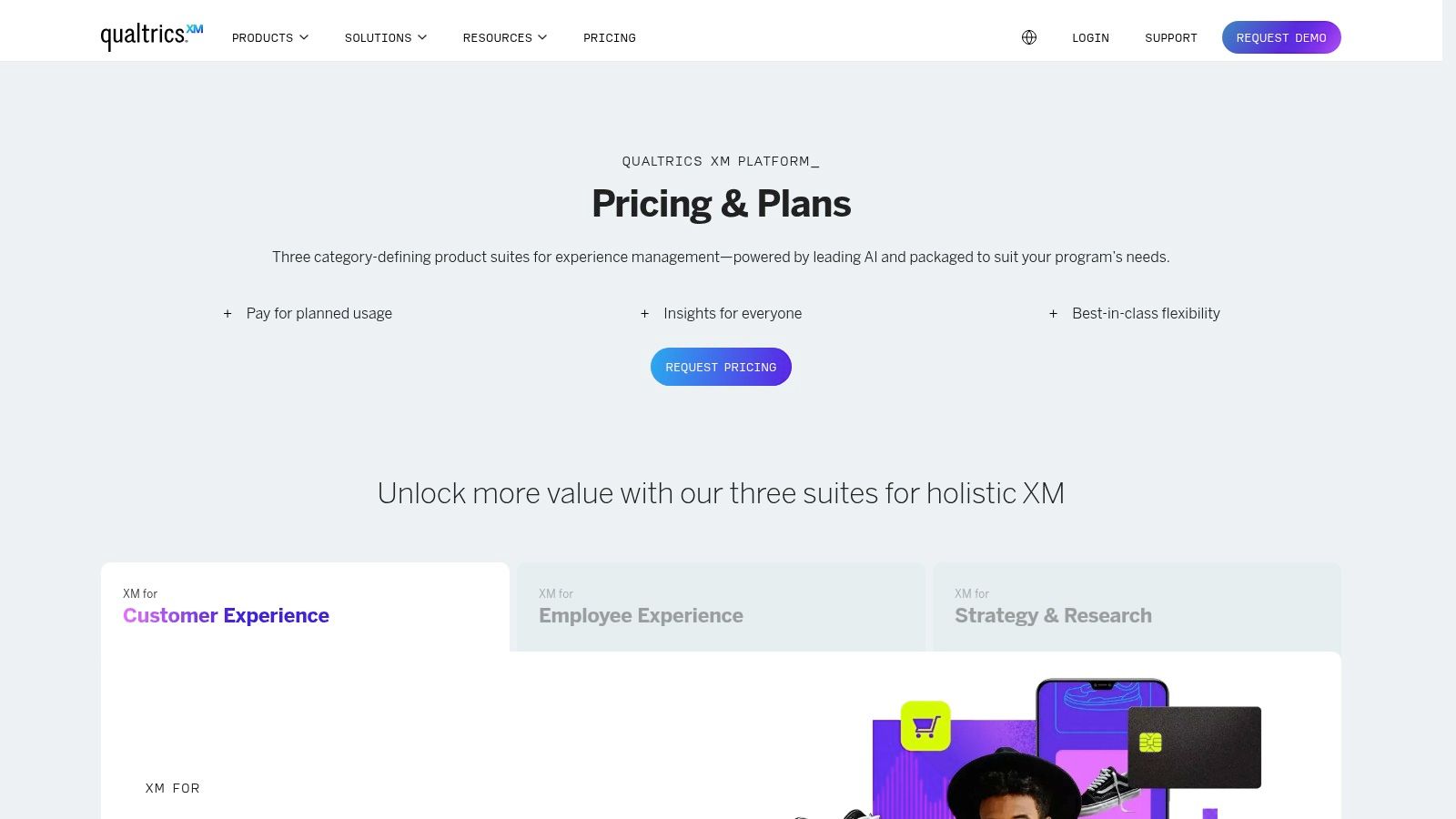
While historically positioned for large enterprises, Qualtrics now offers a self-serve "Strategic Research" plan and a free basic account. This makes its advanced capabilities more accessible to smaller teams and individual researchers. The platform’s strength lies in its ability to manage the entire research lifecycle, from intricate survey design and panel management to deep statistical analysis and dashboard reporting, all within a secure, governed environment.
Evaluation and Key Features
| Category | Analysis |
|---|---|
| Ideal Use Case | Complex quantitative studies like concept testing, price optimization (using conjoint analysis), academic research, and brand tracking. |
| Data Quality | Extremely high. The platform provides tools like ExpertReview to check survey design and prevent bias, ensuring data integrity. |
| Pricing | Ranges from a free basic plan to enterprise-level custom pricing. The self-serve Strategic Research plan offers a more accessible entry point. |
| Unique Feature | The built-in Conjoint and MaxDiff analysis tools, which allow users to design sophisticated trade-off studies to understand feature preferences and price sensitivity without needing separate software. |
Pros:
- Unmatched depth for advanced survey logic, question types, and statistical analysis.
- Strong governance and collaboration features for managing research at an organizational scale.
- Self-serve plans and a free tier have increased accessibility for smaller teams.
Cons:
- Can be overly complex and expensive for simple, quick surveys or one-off projects.
- Accessing the full suite of advanced features often requires engaging with a sales team.
Actionable Tip: For a new product concept, use a free account to build a basic validation survey. If you need to test multiple feature combinations against price points, explore the Strategic Research plan specifically for its conjoint analysis capabilities to create a data-driven product roadmap.
Website: https://www.qualtrics.com/pricing/
10. SurveyMonkey
SurveyMonkey is arguably the most recognized name in online surveys, evolving from a simple poll-creation tool into a comprehensive platform for primary market research. Its primary strength lies in its accessibility and speed, allowing users to quickly design, launch, and analyze studies without extensive training. For teams needing fast, directional insights, it’s one of the best market research tools for self-serve quantitative analysis.
The platform's value is significantly enhanced by SurveyMonkey Audience, its integrated panel that allows researchers to purchase targeted responses directly within the tool. This eliminates the friction of sourcing participants externally, making it ideal for quick concept tests, pricing studies, and brand perception surveys. Its AI-powered survey builder and extensive template library further streamline the process from question creation to data analysis.
Evaluation and Key Features
| Category | Analysis |
|---|---|
| Ideal Use Case | Fast-turnaround primary research, such as concept testing, ad testing, and pricing studies, especially when using the integrated respondent panel. |
| Data Quality | High for user-generated surveys. Panel data from SurveyMonkey Audience is generally reliable for consumer research, but niche B2B targeting can be a challenge. |
| Pricing | Offers various Individual, Team, and Enterprise plans with monthly and annual options. SurveyMonkey Audience responses are purchased separately on a per-response basis. |
| Unique Feature | The seamless integration of the SurveyMonkey Audience panel, which lets you buy targeted respondents directly from the survey creation interface, drastically reducing project timelines. |
Pros:
- Extremely intuitive interface with AI assistance and templates simplifies survey creation.
- Monthly plans provide flexibility for short-term projects without long-term commitment.
- Integrated panel makes sourcing respondents for consumer studies fast and straightforward.
Cons:
- Pricing tiers come with strict response limits, and overage charges can add up.
- Advanced security and governance features are locked into more expensive annual enterprise contracts.
Actionable Tip: For new product concepts, use a MaxDiff analysis template in SurveyMonkey to force respondents to make trade-offs between features. Purchase a small, targeted sample via SurveyMonkey Audience to quickly identify the most valued features before committing to development.
Website: https://secure.surveymonkey.com/pricing/
11. Crunchbase
Crunchbase is a comprehensive database focused on private and public company data, making it an essential platform for mapping competitive landscapes, understanding investment trends, and identifying key players in emerging ecosystems. While not a traditional survey tool, it excels as a foundational resource for sizing markets, particularly within the tech and startup sectors. Its primary value is in providing structured, easily searchable data on funding rounds, investors, acquisitions, and leadership teams.
This platform allows you to quickly build a picture of an industry's health, key competitors, and financial momentum. For market researchers, it's a powerful tool for initial ecosystem analysis, helping to answer questions like "Who are the key funded startups in this space?" and "Which venture capital firms are most active in this vertical?" before diving into deeper qualitative or quantitative research.
Evaluation and Key Features
| Category | Analysis |
|---|---|
| Ideal Use Case | Initial competitive landscaping, investor intelligence, and mapping startup ecosystems to identify key players and funding trends. |
| Data Quality | High for funding and investor data, but relies on a mix of public filings, user submissions, and partner data. Revenue and employee figures are often estimates. |
| Pricing | Offers a limited free tier. Paid plans (Starter and Pro) are self-serve with transparent pricing and a 7-day trial. Enterprise plans are custom. |
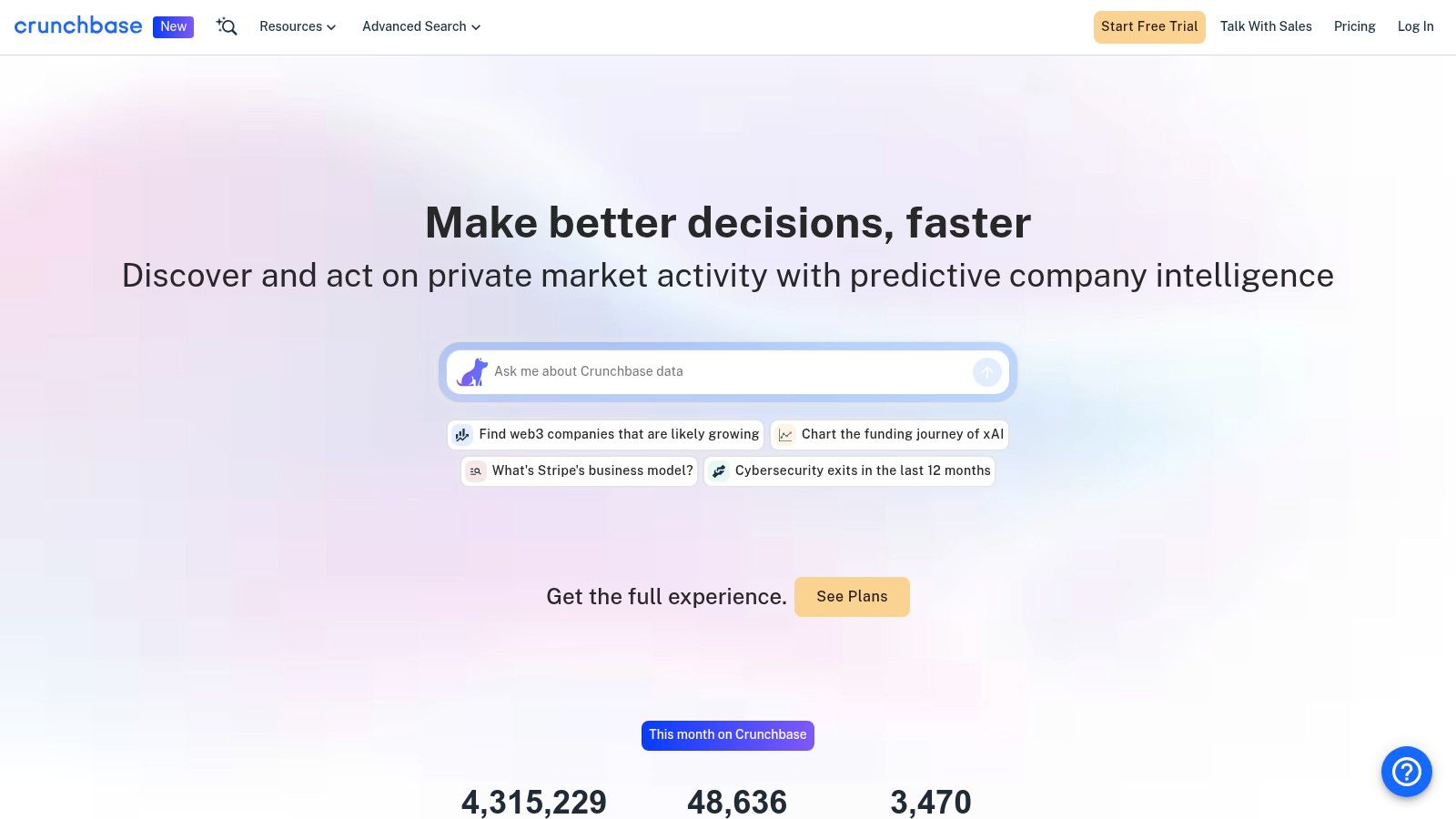
| Unique Feature | The AI-powered search and scouting summaries allow for natural language queries to quickly find and summarize lists of relevant companies, investors, or acquisitions. |
Pros:
- Excellent coverage of startup, VC, and private-company activity.
- Self-serve pricing and a free trial make it accessible for smaller teams.
- Strong integration capabilities, including a Salesforce connector.
Cons:
- Not a substitute for deep financial analysis or revenue benchmarking.
- Data export limits and feature depth are capped by the subscription plan.
Actionable Tip: Use the "Advanced Search" to filter companies by industry, location, funding stage, and recent funding date. Save this search as an alert to automatically track new entrants and investment activity in your target market.
Website: https://www.crunchbase.com
12. CB Insights
CB Insights is a premium intelligence platform designed for deep dives into private markets, emerging tech trends, and venture capital activity. Unlike generalist business databases, it combines proprietary datasets with expert analyst briefings to help corporate strategy, M&A, and innovation teams anticipate market shifts. The platform is particularly effective for identifying disruptive startups, tracking competitor investments, and understanding the technological forces shaping an industry.
The core of its offering is the Strategy Terminal, which provides structured data on millions of companies and thousands of markets. This is layered with predictive analytics, such as its proprietary Mosaic Score, which assesses the health and growth potential of private companies. This forward-looking approach makes it one of the best market research tools for those focused on future trends rather than just historical data.
Evaluation and Key Features
| Category | Analysis |
|---|---|
| Ideal Use Case | Corporate strategy, competitive intelligence, and M&A teams needing to understand private markets, technology trends, and potential acquisition targets. |
| Data Quality | High, combining structured company data with curated analyst research and predictive algorithms. Its focus is on venture-backed and private company ecosystems. |
| Pricing | Enterprise-level; pricing is customized and provided via a sales consultation. It is a significant investment aimed at large organizations. |
| Unique Feature | The proprietary Mosaic Score algorithm, which predicts a private company's future success by analyzing financial and non-financial signals, offers a unique, data-driven perspective. |
Pros:
- Deep, proprietary data on private companies and venture capital.
- Excellent forward-looking analyst research and trend reports.
- Well-suited for high-stakes strategic use cases like M&A and corporate venturing.
Cons:
- Pricing is at a premium, making it inaccessible for small businesses or individuals.
- The depth of data can be excessive for users needing quick, top-level market scans.
Actionable Tip: Use the AI-powered search to ask complex strategic questions like "Which AI startups in logistics raised a Series A in the last year?" This leverages the platform's structured data and analyst content to deliver synthesized, actionable answers beyond simple keyword results.
Website: https://www.cbinsights.com
Top 12 Market Research Tools Comparison
| Tool | Core offering | Key features ✨ | Quality ★ | Price/value 💰 | Target audience 👥 |
|---|---|---|---|---|---|
| StatsHub.ai 🏆 | Instant, slide-ready market reports (PDF + editable) | ✨ Executive summary, regional breakdowns, competitor benchmarking, cited methodology | ★★★★★ | 💰 $15/report (one‑off) — high value; credits if unsatisfied | 👥 Consultants, founders, PM/growth, investors, GTM leaders |
| G2 | Peer-review marketplace for software selection | ✨ Grid/Index/Momentum rankings, review filters, vendor pages | ★★★★☆ | 💰 Free to use (vendor sponsorships possible) | 👥 Buyers shortlisting market-research tools |
| Capterra | Directory + buyer's guide for software | ✨ Category filters, side-by-side shortlists, review sorting | ★★★★ | 💰 Free (sponsored placements appear) | 👥 Early-stage vendor discovery, procurement |
| Similarweb | Digital market & competitive intelligence (web/app) | ✨ Traffic & audience analytics, SEO/ads add‑ons, channel mix | ★★★★ | 💰 Tiered (starter self‑serve → enterprise) | 👥 Digital marketers, competitive intelligence teams |
| Semrush | SEO/ads-led competitive research + Market Explorer | ✨ Market Explorer, Traffic Analytics, modular add‑ons | ★★★★ | 💰 Subscription + paid add‑ons | 👥 Marketers, growth/SEO teams |
| Statista | On-demand stats, charts, dossiers & forecasts | ✨ Citation-ready charts, XLS/PPT exports, Market Insights | ★★★★☆ | 💰 Subscription (individual/business); some paywalled content | 👥 Consultants, presenters, analysts needing slide-ready figures |
| Euromonitor (Passport) | Deep industry & regional subscription database | ✨ Standardized taxonomy, cross-country comparability, report store | ★★★★★ | 💰 Enterprise subscription; one-off reports available | 👥 Corporate strategy, academics, market analysts |
| NielsenIQ (NIQ) | Retail & CPG point-of-sale & panel intelligence | ✨ Scanner data, brand/item tracking, shopper analytics | ★★★★★ | 💰 Enterprise (sales-based pricing) | 👥 CPG, retail category & pricing teams |
| Qualtrics | Enterprise research platform (CoreXM) | ✨ Advanced survey logic, testing, governance, templates | ★★★★★ | 💰 Enterprise tiers; self-serve plans for smaller teams | 👥 Research ops, enterprise insights teams |
| SurveyMonkey | Self-serve survey platform + Audience panel | ✨ AI survey builder, exports, Market Research solutions | ★★★★ | 💰 Tiered plans (monthly/annual); pay-per-response options | 👥 Market researchers, small teams, quick primary studies |
| Crunchbase | Company database for market mapping & investor intel | ✨ AI search, watchlists, exports, integrations | ★★★★ | 💰 Tiered self‑serve pricing; trial available | 👥 VC/BD teams, ecosystem mapping |
| CB Insights | Premium private‑market research & predictive scoring | ✨ Proprietary datasets, analyst research, Mosaic scoring | ★★★★★ | 💰 Enterprise pricing (sales‑based) | 👥 Corporate strategy, CVC, M&A teams |
Choosing Your Tool: A Final Recommendation
Navigating the expansive landscape of market research tools can feel overwhelming. We've journeyed through platforms designed for rapid market scans, deep quantitative analysis, primary survey deployment, competitive digital intelligence, and private company data. The central takeaway is this: there is no single "best" tool, but there is an optimal tool for your specific job-to-be-done. The effectiveness of your research hinges less on the sophistication of the platform and more on the precision with which you match its capabilities to your immediate analytical needs.
The most common pitfall is over-investing in a comprehensive, enterprise-level suite when a more agile, focused solution would suffice. A product manager needing a quick Total Addressable Market (TAM) calculation for a presentation tomorrow has fundamentally different requirements than a corporate strategy team launching a multi-year, global market entry study. Your selection process must begin with a clear, concise definition of the question you need to answer, the required depth of the data, and your operational constraints like budget and timeline.
A Framework for Your Final Decision
To distill this guide into an actionable selection framework, consider your needs across three critical axes: Speed, Scope, and Spend.
Speed: How quickly do you need insights?
- Immediate (Hours/Days): Your best options are pay-per-report or self-service platforms. Tools like StatsHub.ai are designed for this exact use case, delivering slide-ready market sizing and competitive landscapes almost instantly. Similarly, pulling a quick traffic report from Similarweb or a keyword analysis from Semrush provides immediate value for digital-focused questions.
- Moderate (Weeks): This timeline accommodates deploying a survey through SurveyMonkey or conducting a more thorough analysis using data from platforms like Statista or Crunchbase. It allows for some data collection and synthesis without the lead times of traditional research.
- Extended (Months/Quarters): Deep, proprietary research necessitates enterprise-grade tools. This is the domain of Qualtrics for complex survey logic and panel management, or engaging with providers like Euromonitor (Passport) and NielsenIQ for custom reports and authoritative data sets.
Scope: What is the nature of your research?
- Quantitative Sizing: For market sizing, growth rates, and segmentation, focus on data aggregators. StatsHub.ai and Statista are excellent starting points for readily available figures.
- Qualitative & Primary: When you need to understand the "why" behind the numbers, survey platforms are essential. SurveyMonkey is ideal for straightforward questionnaires, while Qualtrics handles complex, multi-branch logic for academic or corporate studies.
- Competitive Intelligence: For a direct look at competitor performance, especially their digital footprint, Similarweb and Semrush are unparalleled. For private company funding, financials, and cap tables, Crunchbase and CB Insights provide the necessary depth.
Spend: What is your budget model?
- Pay-per-Use: Ideal for project-based needs or lean teams. StatsHub.ai leads this category, eliminating subscription overhead for targeted, high-value data pulls.
- Subscription (Self-Serve): A good fit for teams with ongoing needs. Platforms like Semrush, Similarweb, and Crunchbase offer tiered monthly or annual plans that provide continuous access.
- Enterprise Contract: Reserved for large organizations with significant, recurring research requirements. Qualtrics, Euromonitor, and NielsenIQ typically fall into this category, with pricing reflecting their comprehensive data and support.
Final Thoughts on Implementation
Ultimately, the best market research tools are the ones that get used. Select a platform that aligns with your team's existing workflow and technical skill set. A powerful but complex tool that sits idle is a wasted investment. Start small, focus on answering a single, critical business question, and build your research stack from there. By thoughtfully aligning your choice with your specific goals, you can transform data from a simple commodity into a decisive strategic advantage.
Ready to get the market data you need without the high cost and long wait times of traditional research? StatsHub.ai offers on-demand, AI-powered market research reports, delivering everything from market size and growth forecasts to competitive landscapes in minutes. Skip the expensive subscriptions and get actionable, slide-ready insights now by visiting StatsHub.ai.
Ready to move faster?
Generate a market report in minutes, not weeks.
$49, easy to share, and ready for your team.